


How to Raise Your Prices Without Losing Your Best Clients
When I first put my care plans together, the basic one was around $100 a month.
- It covered plugin and theme updates
- An hour of support
- And a monthly performance report
Plenty of my clients started there. Over the next year or two, sometimes longer, the clients would grow and I’d move them to the $350 tier, and a few eventually went past our $800 premium tier.
Every one of those upgrades was a price increase, even though nobody called it that at the time.
They taught me that clients rarely fight a higher price when they can see what they’re getting for it. When they can’t see it, they protest almost every increase.
In this post I’ll walk through how to raise your prices without losing the clients you want to keep.
We’ll cover:
- Why clients push back
- The AI pricing mistake I see a lot right now
- How to have the conversation step by step
A lot of the tactical advice comes from Karl Sakas, who has helped hundreds of agencies do exactly this, so huge shoutout to him.
Why clients fight a price increase
Good maintenance looks like nothing from the client’s side

When a care plan is doing its job, the client doesn’t notice anything. Plugins get updated and backups run every night. A security patch goes on before anyone can exploit the hole, and the site loads the same way on Monday as it did on Friday.
On our side that’s hours of careful work every month. From the client’s chair it looks exactly like nothing, and the only thing they see every month is the invoice.
So when that invoice goes up, the question in their head is a fair one.
What am I getting now that I wasn’t getting before?
Most clients don’t know what goes into a website
The gap goes deeper than maintenance. I remember a discovery call where the brief said small marketing site. Five minutes in, the prospect told me he wanted something like Facebook, with profiles, feeds and messaging, on a budget of about $1,500.
I explained that Facebook’s codebase cost hundreds of millions of dollars and an entire army of engineers. He thought about it for a second and offered two grand.
It sounds extreme, but it’s the same gap you face every time a client looks at your price.
They can’t see the hosting setup, the accessibility checks, the performance work or the security. So they judge your number against the only thing they can see, which is how the site looks.
AI has made the gap wider
We run weekly calls with our community members, and on one of them Nadine, a designer with thirty years in the business, told us about a job she lost to the client’s nephew. He’d convinced the client that AI can build a website in an afternoon, so why pay a professional?
That’s the backdrop agencies are selling against now. An eight thousand dollar proposal lands like a robbery, and Nadine says half of every sales call goes to education before she can even get to the client’s business goals.
Another owner on those calls summed it up perfectly:
“It used to be here’s the price. Now it’s here’s the price, and then a seminar.”
What most people get wrong: lowering prices because of AI
Why dropping your price feels like the right move
The instinct I see a lot right now goes like this. It’s a question I see asked in many Facebook groups: should I lower my prices instead because of AI?
AI makes me faster, my clients know AI makes me faster, so I should drop my prices before they ask me to. I get where it comes from. Something that used to take three days can take an afternoon now, and it feels a bit strange to charge the same for it.
Paul Charlton made a great video on this that really drives the point home: If you drop your price because building got faster, you’re telling the client the build was the product all along. Once they believe that, every future conversation turns into a debate about how long something took you. You’ve also handed them the argument for paying you less again next year.
When a client thinks the build is all they’re buying, you have a positioning problem, and a discount makes it worse.
So what are your clients paying for?

Your clients aren’t paying for the build, they’re paying for everything around the build.
- They pay for someone who understands their business and picks the right approach.
- They pay for someone who catches problems before their customers do and picks up the phone when something goes sideways.
Nadine said it best:
“My best clients are paying for accountability, and an AI can’t get on a call and take the blame when a launch stalls.“
So if AI saves you time, put that time into more of what clients value and let the saved hours show up in your profit. Karl makes the same point, that AI tools should make you more profitable as well as faster.
How to raise your prices, step by step
1. Make the work visible before you touch the price
Start here, because every other step gets easier once the client can see what you do. Keep sending the monthly report, even if you suspect nobody reads it. I know it’s tempting to drop it, and plenty of us have. But its job was always to remind the client that someone is looking after their site. That reminder turns a care plan from a cost they tolerate into something they value.
The other thing that worked for me was unused hours. If a client didn’t use their time that month, I’d reach out with ideas or find areas to make improvements myself.
That could be:
- A speed improvement
- A security tweak
- A change to a page that wasn’t converting.
It kept them engaged and made them see us as a partner in their business. By the time we talked about price, they had a long list of things we’d done for them that they could point to themselves.
2. Raise your price for new clients first
Before you talk to an existing client, decide what a new client pays and put it on your pricing page or proposal template.
Karl recommends this because it anchors everything that comes after it. When you tell an existing client their price is going up, you can also tell them it’s still lower than what new clients pay. That makes their increase feel like a loyalty deal.
If you have prospects on the fence, share the new price and offer to hold the old one if they sign within a set window. It gives them a good reason to make a decision.
3. Sort your clients before you send anything

Karl calls his approach to raising prices a portfolio.
- You list every client and note how valuable they are today
- How much potential they have and how happy they are.
- Then you group them into tiers, so some get a bigger increase, some get a smaller one and some get none at all.
Happy clients who are getting great results can usually take the biggest jump. A client who’s unhappy with your work will leave before paying more, so either fix the relationship first or accept that they’re already on their way out.
4. Have the conversation on a call you already have booked
Tell them on a call, ideally at the end of a regular check-in where you’ve just walked through their results. That way you can hear how they react and answer questions in the moment.
I don’t recommend just sending them an email out of context because that gives them something to react to.
Slow down when you say it. Karl coached one agency whose account managers were rushing through the news in about thirty seconds. Once they rewrote it into a two-minute version with pauses, more than 90 percent of clients accepted.
Here’s roughly how I’d say it, adapted from Karl’s scripts:
“Before we wrap up, I want to give you a heads up on pricing. You’ve been on your current plan for [X years], and new clients now pay [new rate] for the same thing. Because we love working with you, I’d like to keep you at your current price for the next three months. After that, I’d move you to a loyalty rate of [loyalty rate], which stays below what new clients pay and is locked in for a year. What questions do you have?”
Then stop talking and let them respond. The silence will feel awkward, but they need a moment to take it in.
5. Give them a choice

Karl has a simple negotiation shape he calls Reason, Options, Choose.
- You explain why the price is changing
- Offer two or three options you’d be happy with either way
- Then let the client pick
For one client, that might mean keeping their current rate on a twelve-month agreement, or a smaller increase if they want to stay month to month. For a smaller client, it might be the full new rate, or a slightly lower one with a slower turnaround.
Clients push back far less when they get to choose, because the decision feels like theirs.
6. Give plenty of notice and put it on the calendar
Karl recommends giving existing clients at least three months’ notice and raising prices every one to two years. Your costs go up every year whether your prices do or not. Making it a regular thing helps both of you, because a small increase every year or two is a much easier conversation than the one where you haven’t touched a client’s price in six years (which Karl has seen more than once).
7. Be okay with losing a few clients
You’ll probably lose a client or two along the way, and that can be a good thing. When Karl was running client services at an agency, he raised prices by 31 percent and kept every client they wanted to keep. Nadine told me the low-end clients she’s stopped working with were about ninety percent of her headaches and ten percent of her income, and she doesn’t miss them.
8. Upgrade the package along with the number
Remember how I started this post? Most of my own increases happened when a client moved up a tier. If your care plans are packaged well, raising a price can be as simple as showing a client that their business has outgrown the plan they’re on.
The same goes for scope creep. When a client keeps asking for more, it usually means they trust you and got excited about what their site could do. Add those ideas to a list, finish the current phase, and bring them back as phase two with a proper price attached. Some of my best increases started with a client asking for one more thing.
How Atarim makes this easier
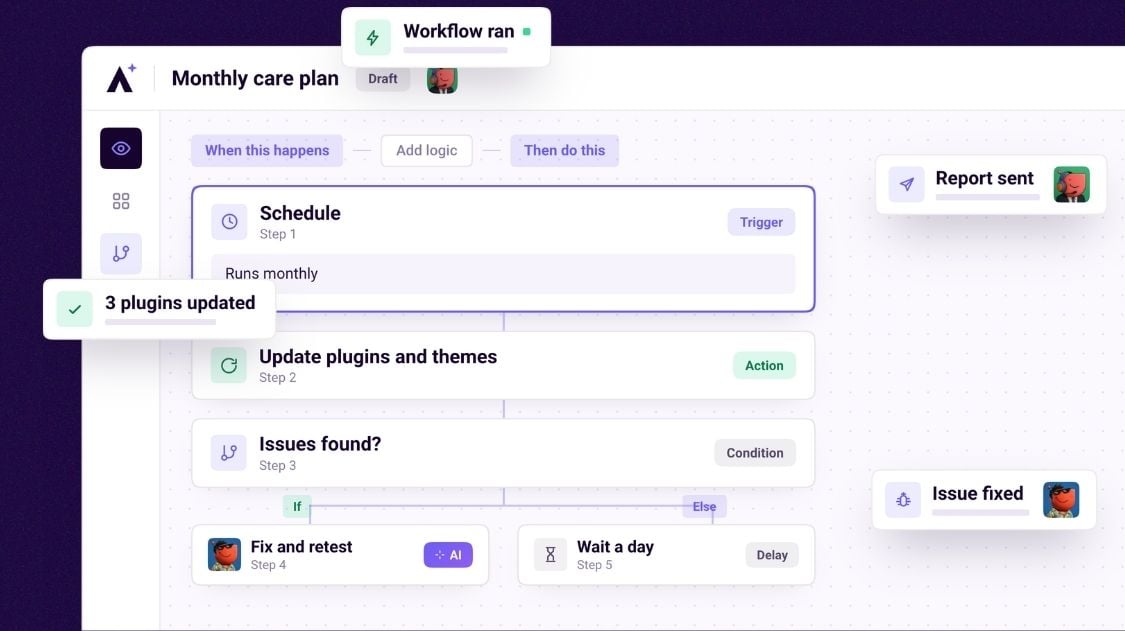
A price rise goes the way the last twelve months went. If a client only heard from you when something broke or an invoice was due, they have nothing to weigh the new price against, and every line of your proposal reads as a cost.
In V5, you set up workflows for each client. These are the regular jobs that run on their site on a schedule you choose, picked around what that client needs:
- Updates run with a backup taken first.
- Security scans check every plugin, theme and WordPress version for known vulnerabilities.
- Performance, accessibility and design reviews run weekly, monthly or quarterly.
- Reviews produce a report, and anything they find becomes a task.
So when a plugin needs patching or a page slows down on mobile, you spot it first and tell the client before they notice. And the fix doesn’t have to wait for a free afternoon, because V5 can do that work too, with nothing going live without your okay.
All of that feeds the monthly report, which lands before the invoice. It goes out under your brand and shows what was checked, what turned up and what got fixed. By the time you raise your prices, they’ve seen months of work they’d never have known about otherwise.
V5 also looks for work worth doing that the client hasn’t asked for yet. On a schedule you set, it goes through all your client sites, spots opportunities, and scopes and prices them at your rate. Nothing reaches the client until you decide to bring it up. That changes the pricing call from defending your current rate to talking about what you’ll do for them next.
Add your first client and see what their next monthly report could show.
Raising your prices gets easier every time
Raising your prices mostly comes down to making sure the client sees the value before they see the new number.
Make the work visible and set the new rate for new clients. Sort your clients into tiers, then have the conversation on a call with options they can choose from. Do it every year or two and it stops feeling like a big scary event and becomes a normal part of running your business.
When was the last time you raised your prices, and how did that conversation go?